Ask ten different Lehigh Valley retirees how they feel about their finances, and most will say some version of the same thing: "We have saved well, but I am not sure we have a plan." That gap between saving diligently and having an actual retirement plan is one of the most common, and most fixable, issues we see among pre-retirees and retirees across Allentown, Bethlehem, and Easton. This article explains why the two are different skills, what a real retirement plan needs to cover, and why local expertise matters when you build one.
The Gap Between Saving and Planning
Saving for retirement and planning for retirement are not the same activity, even though they often get talked about as if they were.
Saving is accumulation. It is the discipline of contributing to a 401(k) or 403(b) year after year, watching a balance grow, and resisting the urge to spend today what you will need decades from now. It is a real skill, and many Lehigh Valley households have practiced it well for thirty or forty years.
Planning is something else entirely: it is the strategic conversion of that accumulated wealth into a sustainable income stream that has to last for an unknown number of years, through an unknown sequence of markets, taxes, and health events. Think of it like the difference between building a boat and actually navigating it across open water. Building the boat well matters enormously, but it does not tell you which route to take, how to read the weather, or what to do if conditions change halfway through the voyage. A household that has saved diligently but never built a formal plan has built a very good boat and is now standing at the dock, unsure which direction to point it.
That uncertainty is not a personal failing. Accumulation and distribution call for different knowledge, different tools, and often a different mindset, and very few people are taught the second half.
Why Generic Rules of Thumb Fall Short
If you have researched retirement planning online, you have run into the familiar shorthand: replace 80 percent of your working income, or withdraw 4 percent of your portfolio each year and adjust for inflation. These rules are not useless. They are reasonable starting points for a first, rough estimate. The trouble is that a rule of thumb was built to apply to everyone in general, which means it was not built for anyone in particular.
Consider three real situations we see often in this area. A physician at Lehigh Valley Health Network or St. Luke's may hold a meaningful position in employer stock or a deferred compensation plan, which changes how much investment risk the rest of the portfolio can reasonably carry. A faculty member or administrator at Muhlenberg College or Lafayette College is likely building retirement income primarily through a 403(b), often alongside a smaller Social Security benefit if years of public service reduced covered wages. A surviving spouse in Bethlehem may suddenly be managing a household's full financial picture alone, on one Social Security benefit rather than two, after decades of shared decision-making.
Ask whether an 80 percent income replacement target or a flat 4 percent withdrawal rate serves all three of those households equally well. It does not, and it cannot, because none of those figures accounts for concentrated stock risk, plan-specific rules, survivor benefit rules, or the tax bracket a household will actually land in. A rule of thumb tells you roughly where to start. A personalized plan tells you where you are actually headed, and it adjusts as your circumstances do.
Five Areas Every Retirement Plan Must Address
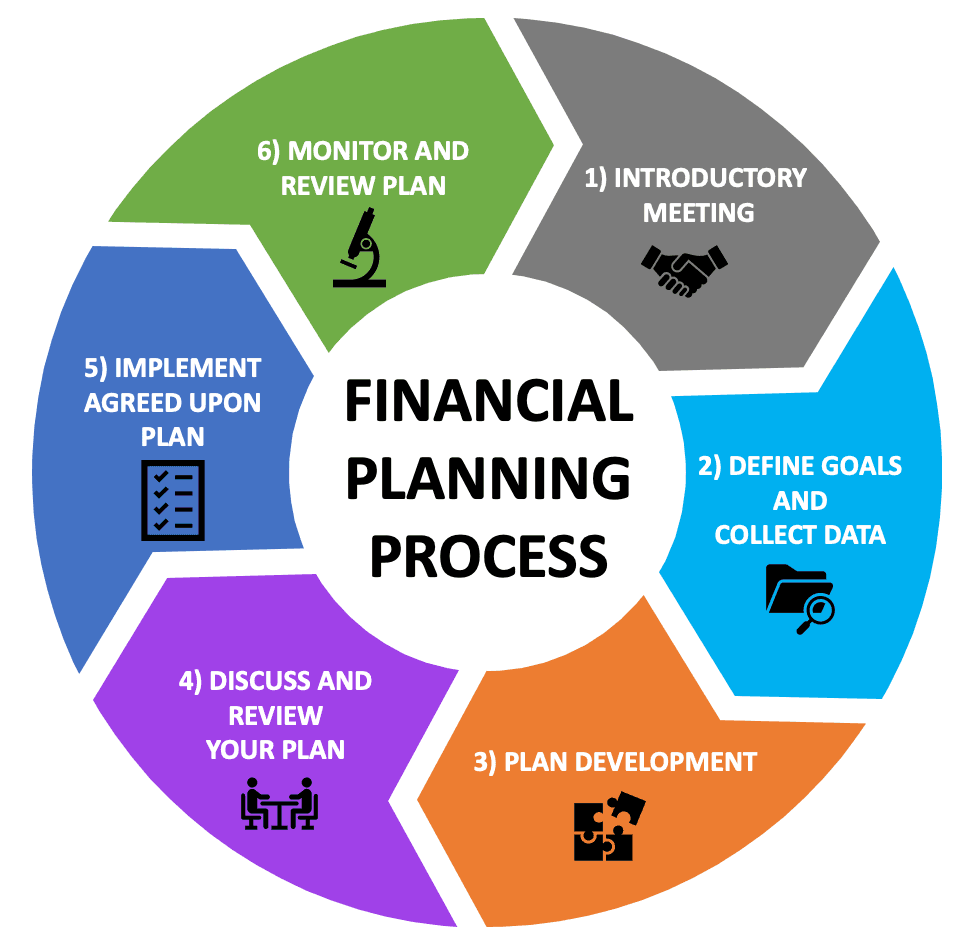
A retirement plan worth the name generally needs to address five interconnected areas. Treating any one of them in isolation tends to create blind spots in the others. The graphic at the top of this article shows the six-step process we walk through with households, from an introductory meeting through ongoing monitoring, and the five areas below are what that process is ultimately building toward.
Income Planning
This is the foundation: deciding when to claim Social Security, how to handle a pension election if one is available, and in what order to draw from taxable accounts, tax-deferred accounts like a 401(k) or 403(b), and tax-free accounts like a Roth IRA. Timing matters enormously here. Claiming Social Security even a few years earlier or later than the optimal point for your situation can meaningfully change your lifetime benefit, and the right withdrawal sequence can extend how long a portfolio lasts. We cover Social Security timing in more depth in our guide to Social Security claiming ages.
Tax Planning
Pennsylvania's tax treatment of retirement income has its own quirks that a national rule of thumb simply cannot account for. The state generally does not tax Social Security benefits, and it treats most eligible retirement plan distributions differently than many other states once retirement age and plan eligibility requirements are met, though the specifics vary by plan type and personal circumstances. Layered on top of that are federal considerations like Roth conversion timing and required minimum distributions, which we discuss in our articles on Roth conversions and RMD rules. Because state and federal rules interact, this is an area where a general answer rarely fits a specific household.
Healthcare Planning
Healthcare decisions carry real financial weight. Medicare enrollment timing, the choice between a Medigap policy and a Medicare Advantage plan, and long-term care considerations all affect a retirement budget. For anyone retiring before 65, bridging the gap until Medicare eligibility begins is its own planning question, one that depends on the healthcare options available in the Allentown, Bethlehem, and Easton area.
Investment Management
Retirement calls for a different posture than accumulation did. During your working years, the primary goal was growth. In retirement, the priorities generally shift toward generating income, preserving stability, and managing longevity, meaning the risk that your money needs to last longer than you originally expected. Part of this shift involves managing what is known as sequence-of-returns risk: the risk that a market downturn early in retirement, combined with ongoing withdrawals, can do lasting damage to a portfolio that the same downturn would not have caused during the accumulation years.
Estate and Legacy Planning
A plan is not complete until it addresses what happens to your wealth after you are gone. That includes confirming beneficiary designations are current (a step that is often overlooked for years at a time), deciding whether trusts make sense for your situation, and coordinating your intentions with your broader tax and income plan so that assets transfer to heirs or charities as efficiently as your circumstances allow.
The Cost of Not Having a Plan
None of this is meant to alarm you. It is meant to be practical about what tends to go wrong when these five areas are never coordinated into a single plan.
Households without a plan run a real risk of outliving their money, simply because no one modeled how long a given withdrawal rate could realistically be sustained. They risk overpaying in taxes for years in a row, not from any single mistake but from small, uncoordinated decisions that compound over time. They risk claiming Social Security at a point that felt right in the moment but was not, in fact, the strongest choice for their situation. They risk being underinsured for a long-term care need that arrives without warning. And they risk leaving a surviving spouse or their children without clear direction at the exact moment clarity matters most.
Every one of these risks is addressable well in advance. None of them requires a perfect crystal ball, only a plan that was actually built before it was needed.
Why Local Expertise Matters
Could a national robo-advisor or a generic online calculator produce a retirement number for you? Certainly. Could it tell you how Pennsylvania treats your retirement account distributions differently from a retiree in Florida or Texas? Could it factor in the specific healthcare systems and insurance options available across Allentown, Bethlehem, and Easton, or the particular retirement plan quirks at Lehigh Valley Health Network, St. Luke's, or a local university's 403(b) provider? Generally, no. That context requires an advisor who works in this market every day.
At Wealthcare of the Lehigh Valley, we work specifically with the households, professions, and life stages common to this region: pre-retirees and retirees, medical professionals managing complex tax situations and concentrated stock positions, higher-education faculty and administrators navigating 403(b) plans, and surviving spouses adjusting to managing a financial picture on their own. You can see the full range of who we help to find where your own situation fits.
Building Your Plan
If you have saved well but have never put a formal plan in writing, you are in good company, and you are also in a position to close that gap. A retirement plan built around your specific income sources, tax situation, health coverage needs, investment posture, and legacy goals will always serve you better than a generic rule borrowed from someone else's circumstances.
We would welcome the opportunity to talk through where you stand today and what a personalized plan could look like for your household. You can schedule a consultation with our team to get started.
Frequently Asked Questions
What is the difference between financial planning and investment management?
Investment management focuses on how your money is invested: asset allocation, diversification, and ongoing portfolio oversight. Financial planning is broader. It looks at your income sources, taxes, healthcare costs, and estate goals together, and it determines how your investments should be positioned to support that full picture. Most retirees need both, but planning is what ties investment decisions to a specific purpose.
When should I start building a formal retirement plan?
Many advisors suggest beginning serious retirement planning five to ten years before your target retirement date, since decisions like Social Security timing, Roth conversions, and healthcare bridging often benefit from years of lead time. That said, it is rarely too late to build or refine a plan. Even retirees already drawing income can benefit from a plan that reviews withdrawal sequencing and tax efficiency going forward.
I do not have a pension. Do I still need a formal plan?
Yes. In some ways, households without a pension need a plan even more, since they are responsible for converting their own savings into a paycheck that has to last. Without a pension's guaranteed income, decisions about Social Security timing, withdrawal order, and investment risk carry more weight, which is exactly what a retirement plan is designed to address.
How often should a retirement plan be reviewed?
A written plan is not a one-time document. Most households benefit from a review at least annually, and additional reviews are worth scheduling after a major life event such as a job change, a health diagnosis, the loss of a spouse, or a significant market move. Tax laws and personal circumstances both change over time, and a plan built five years ago may need adjusting today.
Written by Kevin J. Brey, CAIA
Wealthcare of the Lehigh Valley