
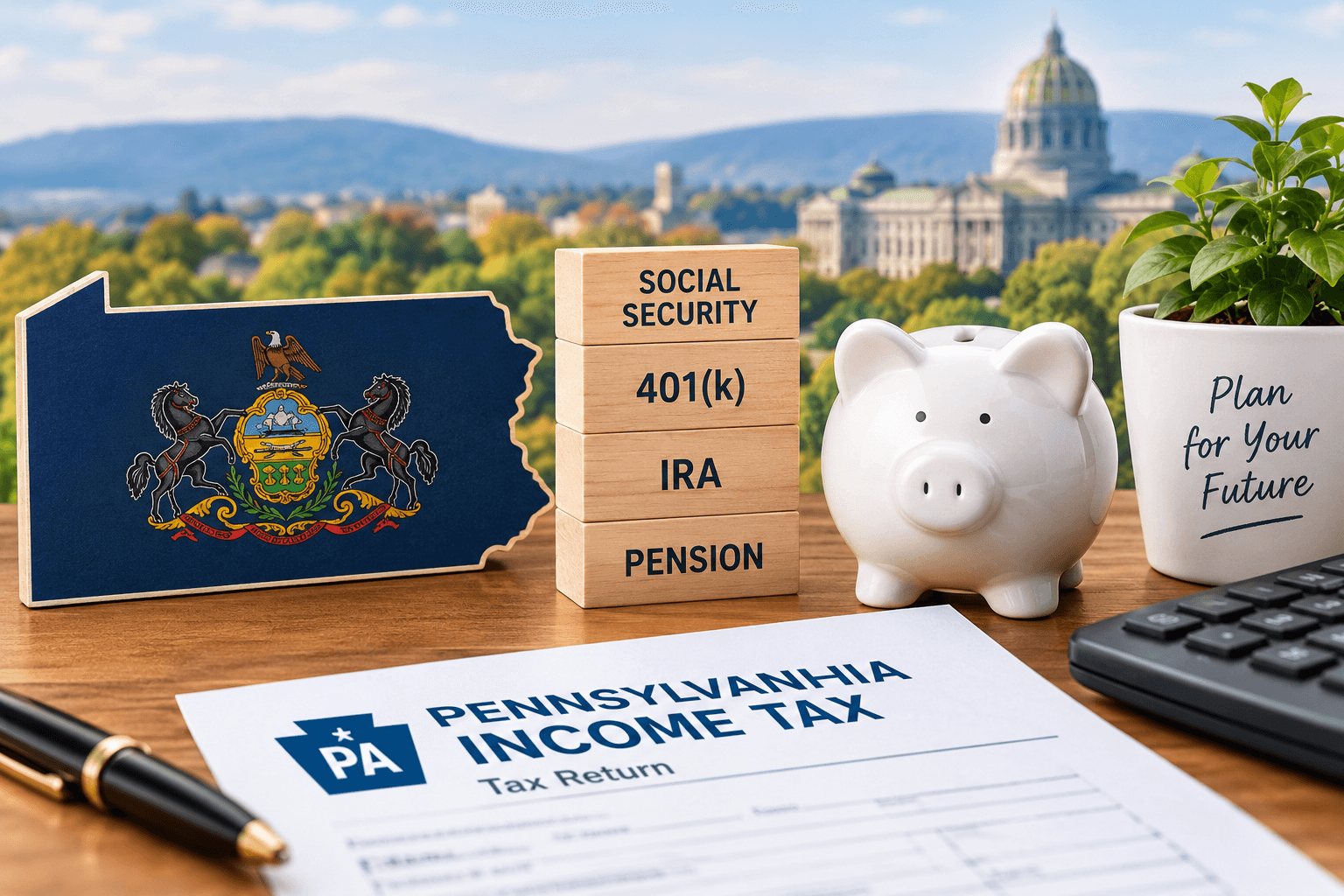
Pennsylvania charges a flat 3.07 percent personal income tax, but it generally does not tax Social Security or distributions from eligible retirement plans taken after retirement. It does tax some other income, such as interest, dividends, and investment gains. Federal tax is separate and may still apply, and rules depend on individual circumstances.
For households across Allentown, Bethlehem, and Easton, the question "does Pennsylvania tax retirement income?" rarely has a single yes or no answer. The result depends on the type of income, the account it comes from, and whether you have retired under your plan's terms. This guide walks through each income type, keeps the state picture separate from the federal one, and lists questions worth raising with a tax professional. It is educational and does not apply to any one household.
Sources and as-of date: Pennsylvania rules come from the Pennsylvania Department of Revenue and the Department of Community and Economic Development, federal rules from the IRS, and Medicare premium rules from the Social Security Administration (SSA). Each is linked where used and was reviewed October 22, 2026. The Pennsylvania return instructions cited are for tax year 2025. Tax rules change, so check each page for the current version.
The short version by income type
These summaries are general and each one has limits that the sections below explain.
- Social Security. Not taxable for Pennsylvania purposes. May be partly taxable federally.
- Pensions and employer plans (401(k), 403(b)). Generally not taxable in Pennsylvania once you have retired and met your plan's retirement requirements. Federally taxable when received, unless the money is Roth.
- IRAs. Generally not taxable in Pennsylvania when received at or after age 59½. Earlier withdrawals may be taxable.
- Roth conversions. Generally not taxed by Pennsylvania if the full amount reaches the Roth IRA. Generally added to federal taxable income.
- Interest, dividends, and investment gains. Taxed by Pennsylvania at 3.07 percent, with some exclusions.
- Local earned income tax. Generally applies to wages and business income, not to Social Security or pensions.
Social Security
The Pennsylvania Department of Revenue answers this directly in its personal income tax FAQ: Social Security benefits are not taxable for Pennsylvania purposes (REV-581, reviewed October 22, 2026). The Department's personal income tax guide lists Social Security and railroad retirement payments among items never taxable as Pennsylvania compensation.
The limitation is that this is a state rule only. The federal picture is covered below, and a household with other income may still owe federal tax on part of its benefits. Our Social Security claiming strategies guide explains how claiming timing and other income can interact.
Pensions and employer plans
For workplace plans, Pennsylvania looks at whether you have retired. The Department of Revenue says commonly recognized retirement benefits are not taxable for Pennsylvania purposes if you retired and met the requirements for retirement under your employer's plan (REV-581, reviewed October 22, 2026). Several points can change the result:
- Retirement conditions matter. Eligibility often turns on a plan's age or years-of-service requirement. Taking money before you meet it may be taxable in Pennsylvania to the extent it exceeds contributions that Pennsylvania already taxed.
- Contributions are taxed up front. The Department's guide to gross compensation says employee contributions to an eligible Pennsylvania retirement plan are included in Pennsylvania compensation, even when they are excluded from federal wages. The benefit is the exemption later. The trade-off is that Pennsylvania takes its share of the contribution during your working years.
- Plan type and eligibility can vary. The same guide notes that being a qualified plan for federal purposes is not controlling for Pennsylvania. For a particular 401(k), 403(b), pension, or deferred compensation plan, confirm eligibility with your plan administrator and a tax professional. Some nonqualified deferred compensation distributions may be treated differently.
- Annuities outside an employer plan. The Department says income from a retirement annuity not sponsored by an employer or not part of an employer's plan is not considered retirement income, and the taxable amount reported federally is reportable as interest.
Our retirement income planning article describes how these income sources can fit together in a plan.
IRAs and Roth conversions
IRAs follow their own age-based rule. The 2025 PA-40 instructions (reviewed October 22, 2026) say IRA distributions are not taxable if they are received on or after age 59½, or paid to the estate or designated beneficiary because of the participant's death. The same instructions say distributions from an IRA, including a federal Roth IRA, are taxable to the extent they exceed previous contributions when taken after retiring but before age 59½.
Roth conversions get special treatment. The Department's preparation guide (DFO-02, reviewed October 22, 2026) says the conversion of a traditional IRA to a Roth IRA is generally not taxable, meaning money moved by a trustee-to-trustee transfer or a rollover within 60 days is generally not subject to Pennsylvania personal income tax. Any amount distributed from the traditional IRA but not put into the Roth IRA, including money withheld for taxes, may be taxable.
The limitation is the federal side. The IRS says a conversion generally results in tax on any untaxed amounts in the traditional IRA, as of October 22, 2026. A Pennsylvania result that looks favorable does not remove that federal cost, and a larger federal income year can affect other items such as Medicare premiums. Our Roth conversion guide covers the trade-offs in more detail.
Investment and other income
Retirement accounts are only part of many households' income. Pennsylvania taxes eight classes of income at the 3.07 percent rate, including interest, dividends, net gains from the sale of property, and net rental income (Department of Revenue, reviewed October 22, 2026). A few features are worth knowing:
- Interest has an exception. Interest from direct obligations of the federal government, the Commonwealth of Pennsylvania, and its political subdivisions is not taxed, according to REV-581. Other interest generally is.
- Losses are handled by class. The Department says a loss in one income class may not offset another class, and gains or losses may not be carried backward or forward. A loss on one investment may therefore not reduce Pennsylvania tax on income of a different type.
- Home sale gains. The Department says capital gains from the sale of a principal residence are excluded for taxpayers who meet the ownership and use requirements.
- No standard deduction. Pennsylvania does not provide a standard deduction or personal exemption, and it allows only a short list of deductions, such as certain health savings account and 529 plan contributions.
For households with concentrated stock or low-basis holdings, our capital gains tax guide for retirees outlines the federal side of selling appreciated positions.
Local earned income tax
Pennsylvania municipalities and school districts may levy a local earned income tax, and the question for retirees is whether it reaches retirement income. The state's local earned income tax return instructions (CLGS-32-1, reviewed October 22, 2026) list Social Security and pensions among non-taxable income and wages and similar pay among taxable income. A retiree who keeps working part-time may still see local tax on that paycheck. Your local tax collector can confirm how the rule applies to you.
What the federal tax picture still includes
Pennsylvania's rules do not change federal tax. The Department of Revenue itself notes that once you retire and begin receiving pension benefits you will pay federal tax on those payments but not Pennsylvania tax (REV-581). Federal items that may still apply include:
- Taxable Social Security benefits. The IRS says benefits may be taxable if one-half of your benefits plus your other income, including tax-exempt interest, exceeds a base amount for your filing status: $25,000 for single filers and $32,000 for married couples filing jointly (as of October 22, 2026). A higher level of income may make up to 85 percent of benefits taxable. The IRS says the exact amount depends on income, benefits, and filing status.
- Traditional account withdrawals. Pre-tax 401(k), 403(b), and IRA distributions are generally included in federal taxable income when received. Required minimum distributions can add to that income in later years. See our required minimum distribution guide.
- Medicare premiums. The SSA says higher-income beneficiaries may pay an income-related adjustment on Medicare Part B and drug coverage premiums, based on a tax return from two years earlier. Federal income in one year may therefore influence premiums later, even when Pennsylvania does not tax the source.
How this connects to planning
Pennsylvania's treatment is one input, not a plan. A few planning questions tend to follow from it, and each has a limitation:
- Which accounts to draw from, and when. Pennsylvania generally treats several kinds of retirement withdrawals the same way, but federal tax can differ between pre-tax and Roth money. The state rule may not be the deciding factor.
- Timing around retirement. Because Pennsylvania ties many exclusions to retirement under plan terms or to age 59½, the date of a withdrawal can change its state treatment as well as its federal treatment.
- Taxable investment income. Interest, dividends, and gains outside retirement accounts may be taxed by Pennsylvania even when retirement withdrawals are not, so the account where an asset is held may matter.
- Life changes. Households adjusting to the loss of a spouse may face changes in filing status, benefits, and income at the same time. Our guide to financial advice for widows and surviving spouses describes what often cannot wait and what usually can.
These are topics to model with a tax professional, not recommendations. Our financial planning process guide explains how they can be organized into one plan, and our tax planning service looks at how they fit together over several years. You can also read about the households we work with on our who we help page.
Questions to bring to your professionals
- Does each of my plans meet Pennsylvania's retirement conditions for the way I plan to take distributions?
- Which of my accounts are traditional, Roth, or taxable, and how does each type interact with state and federal tax?
- If I convert to a Roth IRA, how should the transfer be made so the full amount reaches the Roth account?
- How much of my Social Security could become taxable federally, given my other income?
- How might my income in one year affect Medicare premiums two years later?
- Do I have local earned income from part-time work, and who is my local tax collector?
- Am I eligible for programs such as the Property Tax/Rent Rebate Program?
Frequently Asked Questions
Is Pennsylvania tax friendly to retirees?
It can be for some households. Pennsylvania generally does not tax Social Security or qualifying retirement plan distributions taken after retirement, according to the Department of Revenue. It does tax other income, such as interest, dividends, and investment gains, at a flat 3.07 percent, and federal income tax and local property taxes are separate. How favorable the picture looks depends on your mix of income.
What tax breaks do seniors get in PA?
Pennsylvania excludes Social Security and qualifying retirement distributions from income, and it excludes gains on a principal residence for owners who meet the ownership and use tests. The Property Tax/Rent Rebate Program offers up to $1,000 to eligible homeowners and renters who are 65 or older, widows and widowers 50 or older, and people with disabilities 18 or older, with household income of $48,110 or less (Department of Revenue, reviewed October 22, 2026). The application deadline for 2025 rebates is December 31, 2026. Pennsylvania has no standard deduction or personal exemption.
Does Pennsylvania tax pensions and 401(k) or 403(b) withdrawals?
The Department of Revenue says commonly recognized retirement benefits are not taxable for Pennsylvania purposes if you retired and met the requirements for retirement under your employer's plan. Taking money out before meeting those requirements may be taxable to the extent it exceeds contributions Pennsylvania already taxed. Whether a specific plan and payment qualify depends on plan terms, so confirm with your plan administrator and a tax professional.
Does Pennsylvania tax Roth conversions?
Pennsylvania generally does not tax a conversion of a traditional IRA to a Roth IRA when the full amount moves by trustee-to-trustee transfer or by rollover within 60 days (Department of Revenue, DFO-02). Amounts withheld or not deposited into the Roth IRA may be taxable. Federal tax treatment is different, because a conversion generally adds to federal taxable income for that year.
Does local earned income tax apply to retirement income?
Local earned income tax is generally based on earned income, such as wages and business profits. The state's local earned income tax return instructions list Social Security and pensions as non-taxable for this tax. If you still work part-time, that paycheck may be taxed locally, and your local collector can answer questions about your situation.
Next Step
If you are approaching retirement or already retired in the Lehigh Valley and want to talk through how state and federal taxes may affect your income plan, you can schedule a conversation with our team. Any outcome depends on your circumstances. These related resources may help you prepare:
- Roth conversions: Roth conversion guide.
- Retirement income: Retirement income planning and required minimum distributions.
- Social Security: Claiming strategies.
- After the loss of a spouse: Financial advice for surviving spouses.
- Taxes: Tax planning and who we help.
This article is for general educational purposes only and is not individualized tax, legal, or investment advice. Tax rules change, and results depend on your individual circumstances. Consult a qualified tax professional about your situation.
Wealthcare of the Lehigh Valley