We have written about why financial planning matters for Lehigh Valley pre-retirees and retirees, using the analogy of building a boat and then learning to navigate it. We followed that with a look at why professional fiduciary asset management matters, describing a financial plan as a map and asset management as the vehicle that actually moves you along it. This article completes the thread. If the plan is the map and asset management is the vehicle, retirement income planning is the route itself: the specific path you take, the fuel you carry, and the confidence that you have enough of it to reach your destination without running dry along the way.
That distinction matters more than it might sound. A well-diversified portfolio and a well-written plan can both exist, and a household can still end up without a reliable paycheck in retirement, simply because no one worked out the route connecting the two.
The Six Pillars of Retirement Income
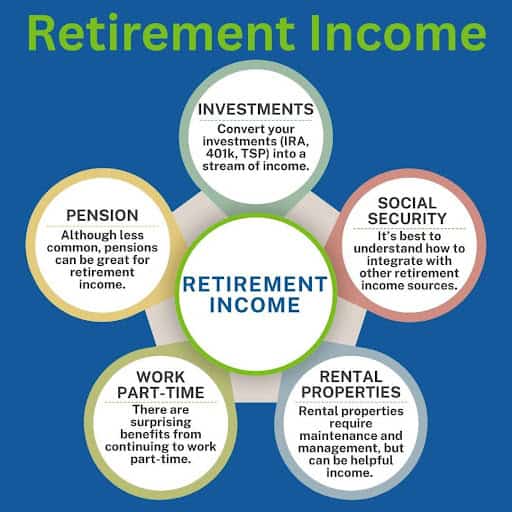
Most Lehigh Valley households approaching retirement have more income sources available to them than they initially realize. The graphic above lays out the six pillars we walk through with clients:
- Pensions. Although less common than a generation ago, a pension can be one of the strongest pieces of a retirement income plan when it is available, and the decisions around how to elect it deserve real attention.
- Investments. Converting a 401(k), 403(b), IRA, or TSP balance into a stream of income is a fundamentally different exercise than accumulating that balance in the first place.
- Social Security. Understanding how to integrate a Social Security benefit with your other income sources, rather than claiming it in isolation, is one of the highest-leverage decisions in retirement income planning.
- Part-time work. Continuing to work in some capacity, even a few hours a week, has surprising benefits beyond the paycheck itself, including a reduced draw on savings and continued access to purpose and routine.
- Rental properties. Rental income can be a durable piece of a retirement paycheck, but it requires ongoing understanding and management to remain reliable.
- Retirement income. All five of these sources exist to serve one purpose: a sustainable, coordinated stream of income that supports the retirement you actually want to live.
What a Retirement Income Plan Actually Is
A retirement income plan is the deliberate coordination of every income source available to a household, Social Security, a pension if one exists, retirement account withdrawals, taxable investment accounts, rental income, and part-time work, into something that functions like a reliable paycheck. It answers questions a portfolio statement never will: How much can we safely draw this year? Which account should that withdrawal come from? What happens to our income if one spouse passes away? How does next year's Required Minimum Distribution affect this year's tax bracket?
This is a different discipline than investment management, and the distinction is worth being precise about. Investments are the engine: they generate the growth and eventual cash flow that funds a retirement. Income planning is the navigation system that determines when, where, and how much to draw from that engine so it lasts as long as you need it to. A household can have an excellent engine and still run out of road if no one is navigating, which is exactly the gap this article is meant to address.
Why the Order of Withdrawals Matters
Once a household has multiple accounts, taxable brokerage accounts, tax-deferred accounts like a 401(k) or 403(b), and tax-free Roth accounts, the order in which money is drawn from each one has a real, compounding effect on how long the overall portfolio lasts and how much tax is paid along the way.
A common default is to draw taxable accounts first, tax-deferred accounts second, and Roth accounts last, since this sequence generally allows tax-deferred assets more time to grow before their eventual withdrawal, and preserves the tax-free growth of Roth assets for as long as possible. But a strict version of that default is not right for everyone. Filling up a lower tax bracket each year with tax-deferred withdrawals, even before it is strictly necessary, can sometimes reduce lifetime taxes compared to waiting until Required Minimum Distributions force larger withdrawals later. We cover the RMD side of this in our guide to required minimum distribution strategies and the case for proactively drawing down tax-deferred balances in our guide to Roth conversions in a retirement income plan.
Withdrawal sequencing also interacts directly with Social Security. Because up to 85 percent of a Social Security benefit can become taxable depending on a household's other income, the size and timing of withdrawals from retirement accounts can push more of that benefit into taxable territory in a given year. Claiming age adds another layer: since a benefit claimed early is permanently reduced and a benefit claimed later is permanently increased, the withdrawal strategy used in the years before claiming can be shaped to bridge that gap. Our guide to Social Security claiming ages goes into that decision in more depth. None of this is a decision to make in isolation. A withdrawal order that ignores Social Security taxation, or a claiming decision made without regard to the accounts funding the years before it, tends to leave money on the table that a coordinated plan would have captured.
Sequence-of-Returns Risk: The Danger Unique to Early Retirement
One risk deserves particular attention because it is easy to underestimate and expensive to experience: sequence-of-returns risk. During your working years, a market downturn is uncomfortable but usually recoverable, since you are still contributing and have years for a recovery to play out. In retirement, the same downturn behaves very differently if you are simultaneously withdrawing income from the portfolio, because each withdrawal taken during a decline locks in a loss that a market recovery can no longer undo for those dollars. Two retirees with identical average returns over a twenty-year retirement can end up with dramatically different outcomes depending on nothing more than which years the down markets happened to fall in.
A well-built income plan addresses this risk before it arrives, rather than reacting to it after the fact. A cash reserve covering a year or more of expenses can allow a retiree to avoid selling investments at a low point, drawing from cash instead until markets recover. A flexible withdrawal strategy, one that can flex downward in a difficult year rather than holding to a fixed dollar amount regardless of market conditions, reduces how much permanent damage a downturn can do. Dynamic spending approaches, where discretionary expenses are trimmed temporarily during a downturn, serve the same purpose. None of these tools eliminate market risk, but together they are what stand between a bad year in the market and a permanently damaged retirement.
The Cost of Getting Income Planning Wrong
The risks of an uncoordinated approach to retirement income tend to show up gradually, which is part of what makes them easy to miss until they compound.
Households without an income plan risk outliving their assets, simply because no one modeled how a given withdrawal rate would hold up across a multi-decade retirement. They risk unnecessary tax drag, paying more than they needed to over many years because withdrawals were never sequenced with tax brackets and RMDs in mind. They risk claiming Social Security at a point that felt convenient rather than optimal, permanently locking in a smaller benefit than their situation could have supported. They risk being forced to sell investments at a market low simply because a bill came due and no cash reserve or flexible source of income was available to cover it instead. And they risk leaving a surviving spouse without a coordinated income strategy at the exact moment one is needed most, managing a household's full financial picture alone on one Social Security benefit rather than two, often for the first time.
Every one of these outcomes is avoidable with a plan built in advance. None of them require perfect foresight, only a route that was mapped out before it was needed.
Why Local Expertise Matters
A generic retirement calculator can estimate a withdrawal rate. It cannot tell you how Pennsylvania's tax treatment of retirement income changes the math for a household in Allentown compared to a retiree in a state that taxes retirement distributions more heavily. It cannot account for the specific pension and 403(b) provisions at Lehigh Valley Health Network, St. Luke's, Lehigh University, or Moravian University, or the deferred compensation and equity arrangements common among the medical professionals we work with. And it certainly cannot walk a surviving spouse through restructuring an entire household's income strategy on a single benefit, or help a household with a concentrated stock position figure out how that position should factor into a withdrawal order.
At Wealthcare of the Lehigh Valley, income planning is built specifically for the households, professions, and life stages common to this region: pre-retirees and retirees converting savings into income for the first time, medical professionals managing complex compensation and tax situations, higher-education faculty and administrators drawing from 403(b) plans, surviving spouses adjusting to managing income alone, and clients whose retirement income needs to account for a concentrated stock position. You can see the full range of who we help to find where your situation fits.
Building Your Income Plan
A financial plan tells you where you are headed. Fiduciary asset management gets you moving. A retirement income plan is what makes sure the route you take actually gets you there, with enough fuel in reserve for the parts of the trip you cannot fully predict. If you are approaching retirement, already retired, or simply unsure whether your income sources are coordinated as well as they could be, that is exactly the conversation worth having now, before a market downturn or a claiming deadline forces the decision.
We would welcome the opportunity to walk through your specific income sources and what a coordinated plan could look like for your household. You can schedule a consultation with our team to get started.
Frequently Asked Questions
What is the difference between a retirement income plan and an investment portfolio?
An investment portfolio is the engine: the collection of assets that generates growth and, eventually, cash flow. A retirement income plan is the navigation system layered on top of it, deciding which accounts to draw from, in what order, and how much to withdraw each year so that Social Security, pensions, investments, and other sources work together as a coordinated paycheck. You can have a well-built portfolio and still lack an income plan, and the two problems require different solutions.
How do I know if my withdrawal rate is sustainable?
Sustainability depends on your time horizon, portfolio composition, other guaranteed income sources, and your flexibility to adjust spending in a down market, not on a single generic percentage. A withdrawal rate that is sustainable for a retiree with a pension and modest expenses may be far too aggressive for someone relying entirely on savings. This is best evaluated through a personalized projection rather than a rule of thumb.
Should I take Social Security early or wait?
It depends on your health, other income sources, tax situation, and whether you are married, since spousal and survivor benefit rules can change the optimal claiming age significantly. Claiming early locks in a permanently reduced benefit, while waiting increases it, but neither answer is universally correct. We cover this in more detail in our guide to Social Security claiming ages.
What happens to my income plan if the market drops right after I retire?
This is called sequence-of-returns risk, and it is one of the most damaging risks in early retirement, since withdrawals taken during a downturn lock in losses that a portfolio may never fully recover from. A well-built income plan addresses this before it happens, through cash reserves, flexible withdrawal strategies, and a mix of income sources that reduces how much you need to sell during a decline.
Written by Kevin J. Brey, CAIA
Wealthcare of the Lehigh Valley